
Some time ago, I mentioned that I'm growing this garden with a bottom-up approach. I also find myself referencing that term in new posts. So in this post, I'll explain more in depth what I mean by it and why I do it this way.
📌
Note: In this post, I specifically talk about personal websites. Websites with a single person behind them. I don't think this applies to business websites or other kinds!
The top-down approach
Before I jump into what I mean with posting with "a bottom-up approach", I need to explain the opposite of that, which would be a top-down approach to making and having a personal website.

When creating a website top-down, you start with a general idea of your identity and beliefs, the things that make you you, the ways you work, what you care about... Your philosophy, values, perspective, experience…
From that identity you decide and organize the future contents of your website. You think about the topics, categories and pages that should be there, according to your defined philosophy. And you build a website with a structure that follows that system.
And finally, from that, you start creating posts, adding information to pages, writing content for the website — according to what you decided to write about and making it fit within that pre-determined setup.
Simplified, the process looks something like this:
Identity:
"I am x , and I believe y and z ."
Organization:
Deciding to post about a , b and c , and structuring the website around those topics.
Creation:
Creating, writing or posting about a , b and c .
This top-down approach is the traditional way of making a website, and it absolutely has a reason to exist. When things are very clear and specific from the beginning, when following a marketing strategy and thinking about niche, target audience… this approach makes sense. But for those of us who don't fit into the idea of niche, it's really difficult and even counterproductive to create a website top-down.
Why it doesn't work for me
(and why it might not work for you)
Identity isn't fixed
To me, shaping the initial identity before creating seems upside down. For me, creation shapes identity — it is the thing that brings me the most clarity about what I believe in, what I like and who I am as a creative. And it's also something that isn't fixed. Our identity, philosophy, values, perspective and experience aren't found or discovered once in our lifetime, in a magical breakthrough. We change, grow, evolve, learn new things, gain more experience, change our priorities… So why should our current idea of who we are and what we care about determine so much?
Who am I?
Finding that definition in the first place — answering the "who am I" question — seems like the most difficult thing to do, especially for people who are curiosity-oriented, multidimentional, multipassionate or who are forever learning about themselves and their work, myself included. We can't fit all of our interests into a clear and digestable definition. Not a lasting one, anyways.
The perfect structure
The organization step in a top-down approach — where you decide the structure, contents and distribution of the website — ends up being a big project, where you have to find the "perfect" solution for you. And while it is important to have a website with a clear structure, for me, it doesn't need to be finished, nor perfect, nor optimized. What I've learned is that it needs to be flexible: easy to change and expand.
Limited creation
For me, creating posts or pages on a website based on a rigid and pre-determined structure or a limited number of topics would feel limiting and forced, which would make it that much harder to create. I would inevitably create from a place of obligation, to fit the "perfect" structure I designed. And if a new idea would pop up that didn't fit the existing system, I'd need to either discard it, adapt it to make it fit, or scratch the whole system and start over from the new things I'd have learned.
And so we'd be back at square one. Inevitably, unless you're so focused and never change your mind (couldn't be me), the top-down approach leads to needing to repeat the process in a big way, from the top. Because the approach isn't made for ongoingness. So if you change your mind, you need to reinvent the wheel, that is, redesign your website for the millionth time.
The first 3 times I made/remade my website, I did it with a top-down approach (I didn't know there was another option yet). Need I say more? I mean, I redid it every year for 3 years!!
The bottom-up approach
If the top-down approach puts identity at the top, the bottom-down approach puts creation at the top, followed by organization and finally identity.

With creation at the top — and so without a pre-defined and rigid idea of what we need to create — we can create, write and share about what's most present at any given moment, from a place of inspiration, authenticity and passion, where ideas are regenerative. The ideas and concepts that keep coming back, the interests we get drawn to, the things we currently struggle with, the things we learned recently, the things we're curious about… It's about exploring, expressing and accumulating (over time) the things that are already in our head and the things that we feel called to make.
From that, we organize and connect what we've created — we make sense of it. In website terms, this means we add tags, categories, we link posts to other posts. And it could also mean making mind maps for yourself to make sense of the contents and their connections. This is an ongoing process, since you're always creating more and more.
And finally, from both creation and organization, you start to show, notice, uncover and shape identity. And this happens very naturally — it is found through creation, not before it. The same way that journaling makes you know yourself better, creating and sharing shapes your website's identity. In website terms, your identity, essence, philosophy is integrated in the website through its content — and, optionally, refined, condensed or defined by you, for clarity purposes, or for your about page, for example.
With time, this approach becomes much more organic and less linear. It isn't just creation → organization → identity, but something more like this:
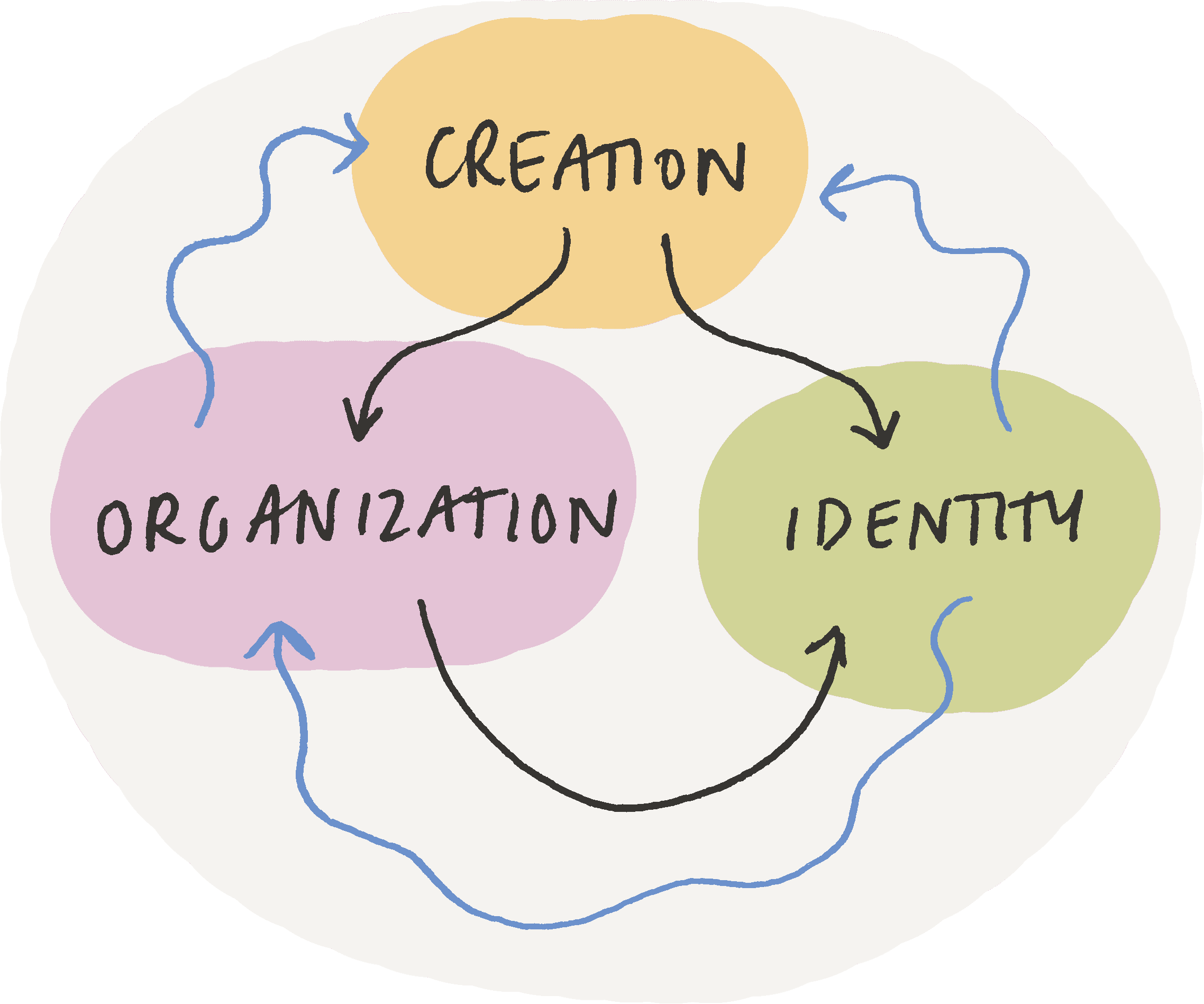
In other words, it is a system that feeds back into itself, because from organization and identity we can also find inspiration for creation. And so it's an ongoing process, you always come back to each of the "steps". That's why this garden has that name, because I equate it to planting seeds and plants (the creation), then fertilizing, pruning and transplanting (the organization), while a unique set of interconnected roots grows underground (identity). So you're always working on all three, but always with creation at the source.
This approach may not be the most efficient, it isn't results-driven or "optimized for conversion". It might not be for everyone, but it's the most real, aligned, comfortable and natural way for me to share things on the internet, which makes it the best and only way for me. The times I made my website top-down, I didn't follow through. And since inhabiting my website in a bottom-up way, I've had the most fulfilling and regenerative experience in keeping this website, and it's been much more visited & loved by others, too. That's not to say it is the best way for everyone, but if you feel stuck in a place of obligation to your website, or you're following all the "right" ways, but some part of you rejects them, building and having a website with a bottom-up approach might be the actual right way for you.
I plan on writing more posts about this, where I'll explain how I apply this approach practically: the structure, the elements, how to actually start a bottom-up website… But until then, you can read more about my personal website philosophy in these posts: